Example inspection, as commissioned once: fixed ROI, fixed thresholds (residual 0.06, minimum blob 8 px, hole gauge grey level set once on the golden image), exclusion mask learned on the clean golden image, no autofocus, no exposure control, no pose finding. Two checks per image: five injected defects (scratch, dent, pore cluster, crack, stain) must each be found with no false alarm, and the through-hole diameter must be within +-0.05 mm of the exact value. Each cell is one rendered image from the twin (135 images in total, resolution 24 px/mm, ground truth exact). All numbers below come from this run.
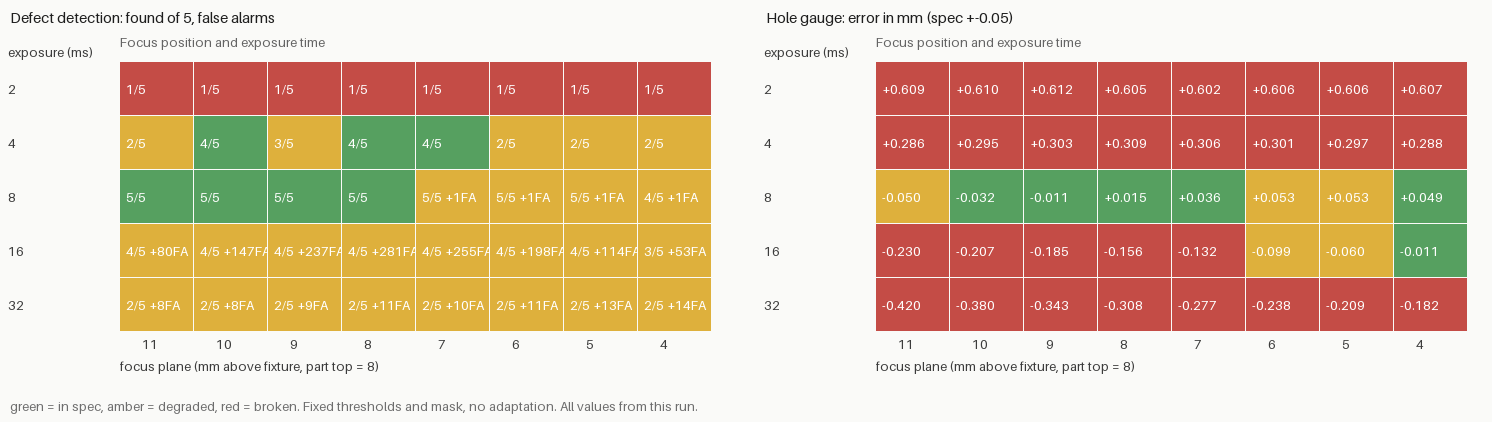
3 of 40 settings keep both checks in spec. At exposure = 8, the checks hold for focus plane in [10, 9, 8]. At focus plane = 10, they hold for exposure in [8].
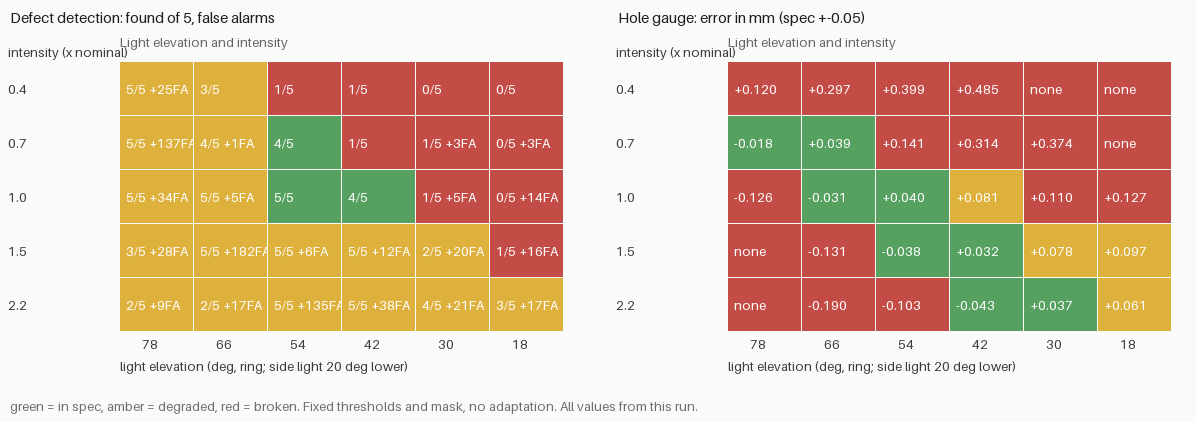
1 of 30 settings keep both checks in spec. At intensity = 1.0, the checks hold for light elevation in [54]. At light elevation = 54, they hold for intensity in [1.0].
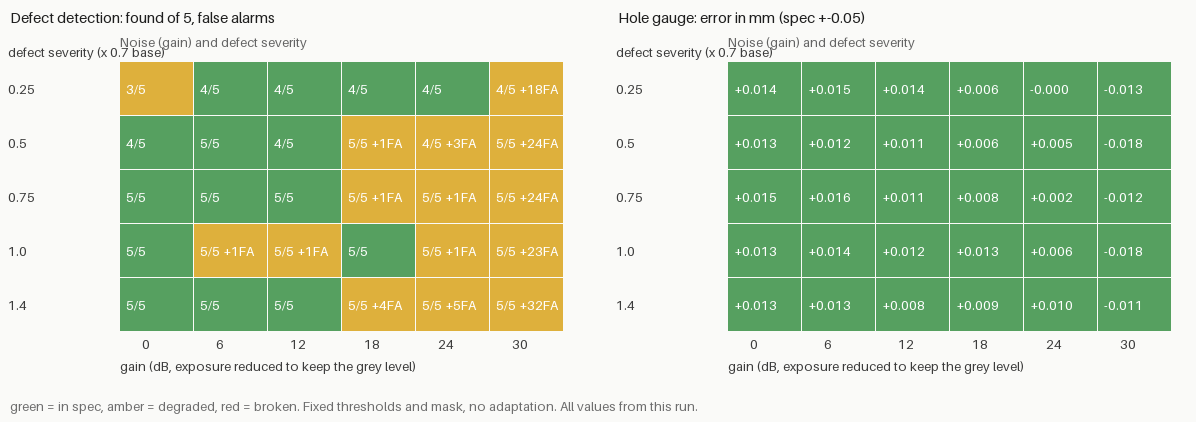
15 of 30 settings keep both checks in spec. At defect severity = 0.25, the checks hold for gain in [6, 12, 18, 24]. At gain = 0, they hold for defect severity in [0.5, 0.75, 1.0, 1.4].
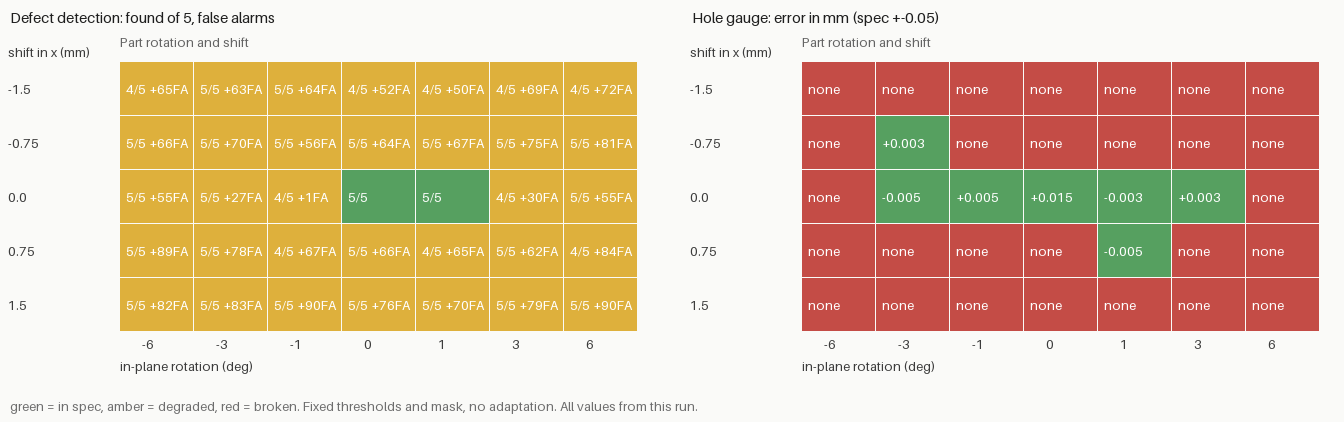
2 of 35 settings keep both checks in spec. At shift in x = 0.0, the checks hold for in-plane rotation in [0, 1]. At in-plane rotation = 0, they hold for shift in x in [0.0].
Green cells are conditions where the program as commissioned stays in spec. Red cells are where it breaks. A real project repeats this on your station with your camera, optics, light and program, and adds held-out real images to check the twin against them. Synthetic part and example program: not customer data.