Testing a vision system before commissioning
In short: Use test images whose right answer is known exactly, and build in the faults that are rare on the real line, in graded steps. Then you see before go-live at which defocus, stray light, dust or pose shift your inspection flips.
Five steps
- Fix the specification. Measured quantity, tolerance and a fault list: what can go wrong on the line?
- Fit a camera model. From about ten images of the station: noise, blur from the edge profile, vignetting.
- Render the scene with ground truth. The part geometry is the input, so the true measurement is known.
- Inject faults in steps. Defocus, stray light, dust, pose shift, exposure drift, four or five levels each.
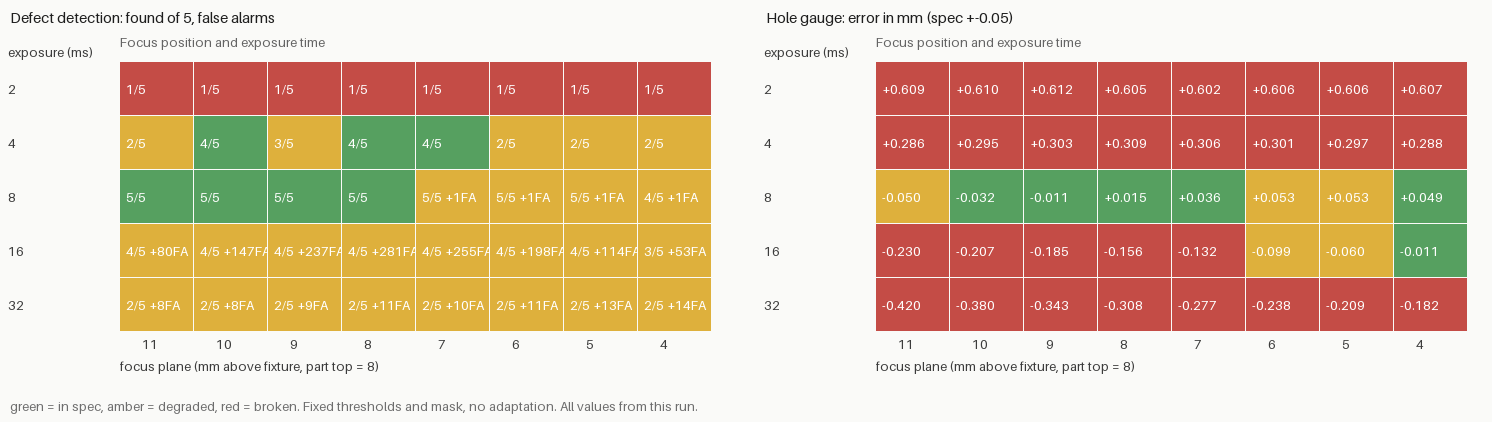
- Run the inspection and read off the limit. The level where the pass rate drops below your threshold is the operating limit. Put it in CI to re-check after every change.
The cross-check
A twin is only useful if it matches the station. Compare it with images that were not used for the fit: noise, edge width, brightness, measured value. The stability report shows the result of such sweeps.
Questions
How many images do I need for a twin?
About ten representative images of the same station fix the camera parameters noise, blur and vignetting. Surface texture and reflections need more, and the report says what is not covered.
Why are real images not enough for testing?
Real images have no known truth and rarely show the rare faults. Rendered images have exact truth and can carry faults in graded steps.